
If you rent in Washington and want to move out, you need to give your landlord written notice. Most people search for a "30 day notice," but for a month-to-month tenancy the state law sets the minimum at 20 days before the end of your rental period. Your lease might ask for 30, so check it first. This guide explains the rule, shows you how to count the days, and gives you a sample letter to copy.
This post explains the basics for typical month-to-month rentals. Your lease and your situation may add requirements. If you are unsure, ask your property manager or a qualified attorney.
How much notice do you actually need?
For a month-to-month tenancy, Washington law (RCW 59.18.200) says either side ends the tenancy with written notice of at least 20 days before the end of a rental period. The period is usually a calendar month, which means the tenancy ends on the last day of the month.
Two things matter in practice:
- Your lease can ask for more. If it says 30 days, give 30. Using the longer period keeps you safe on both counts.
- The date matters as much as the length. Your notice has to arrive at least 20 days before the end of the period, not 20 days before the day you happen to pick.
How to count the days
Say you pay rent on the first and your rental period ends on the last day of the month. You want to be out by December 31.
Twenty days before December 31 is December 11. To be safe, deliver your notice by December 10. If you wait until December 15, your notice does not cover December, and you may owe rent through January.
Give your notice at least 30 days before the move-out date even if the law only requires 20. It leaves room for mail delays, a weekend or a miscounted day, and it matches what most leases ask for.
Fixed-term leases are different
If you signed a lease with an end date, such as 12 months, the notice rules above mostly apply to month-to-month tenants. A fixed-term lease usually means you owe rent through the end date, whether or not you stay.
Read the lease for two things: whether it asks you to confirm in writing that you are leaving at the end of the term, and what happens if you stay past the end date. Many leases convert to month-to-month after the term. If you need to leave early, talk to your property manager before you stop paying. Some situations, such as military orders or domestic violence, have special protections under state and federal law, so ask if one applies to you.
For more on how leases are structured, see our overview of lease agreements.
What to put in your notice
Keep it short and factual. A clear notice includes:
- Your full name and the rental address
- The date you are writing
- A clear statement that you are ending your tenancy
- Your move-out date, matched to the end of your rental period
- A forwarding address for your deposit and final paperwork
- Your signature
Skip the reasons, complaints and negotiations. The notice is a record, not a conversation.
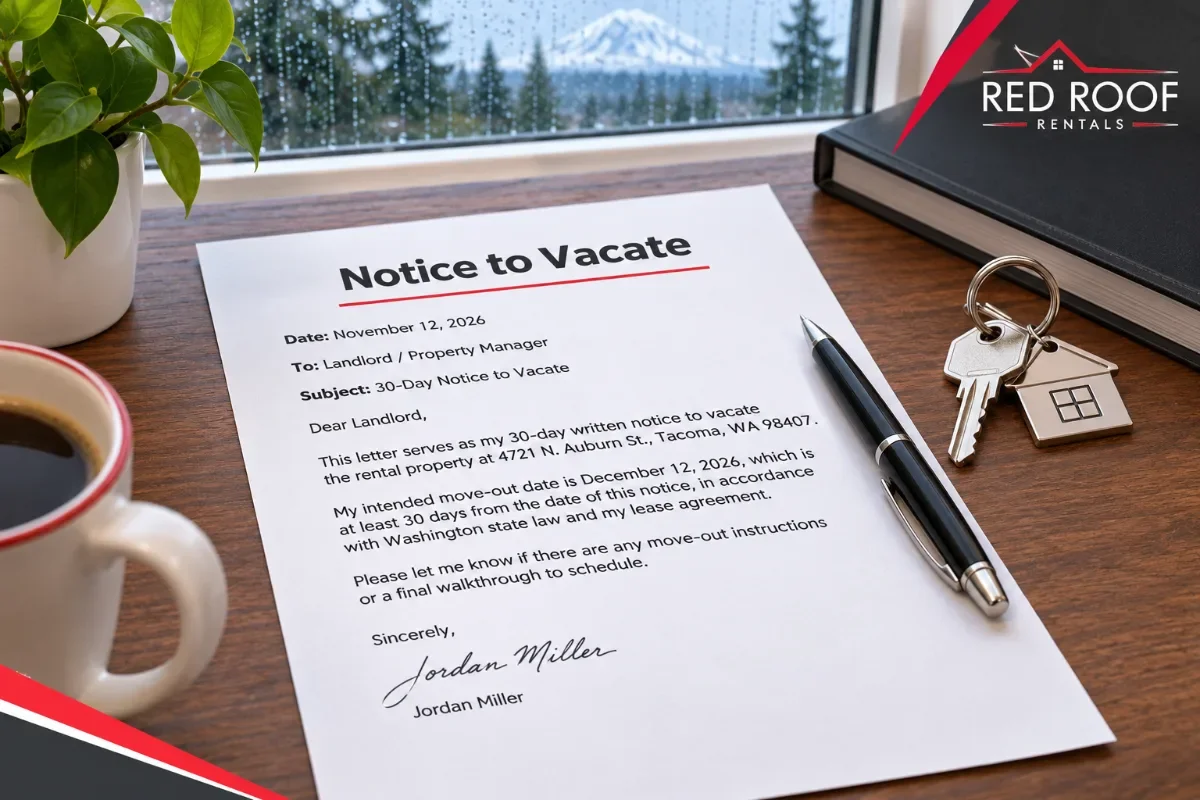
Sample notice letter
You can copy this and fill in the blanks.
[Your full name] [Rental address, city, WA ZIP]
[Date]
[Property manager or landlord name] [Company and address]
Re: Notice of intent to vacate
Dear [Name],
This letter is my written notice that I will be ending my month-to-month tenancy at [rental address]. My move-out date will be [date, matching the last day of your rental period].
Please send my security deposit and any related statement to my new address: [forwarding address].
I would like to schedule a final walkthrough before I leave. Please let me know what times are available.
Thank you, [Signature] [Printed name, phone and email]
How to deliver it so it counts
Follow whatever delivery method your lease describes. If it is silent, use two methods, such as an email to your property manager plus a printed copy delivered in person or by mail. Keep a photo or receipt with the date.
Before you hit send, make sure of three things: the notice is signed, it is addressed to the right person and it lists your forwarding address.
Before you move out
Giving notice is the start of the process, not the end. Take these steps to protect your deposit and avoid surprise charges:
- Ask what the move-out cleaning and repair standards are, and read your move-in condition report.
- Schedule a walkthrough so you can fix small issues before the final check.
- Clean thoroughly and photograph every room, with date stamps, on your last day.
- Return all keys and garage or gate openers, and get a receipt or written confirmation.
- Confirm your forwarding address in writing.
Washington law requires a landlord to return your deposit, or send a written statement explaining what is being kept, within 21 days after the tenancy ends and you have vacated (RCW 59.18.280). For tips on how deductions work, read our guide to security deposits.
Common mistakes to avoid
- Giving notice verbally. Always put it in writing.
- Counting from the wrong date. Notice should cover the end of the rental period, so count backward from that date.
- Forgetting the forwarding address. Your deposit statement has to go somewhere.
- Leaving without a walkthrough. You lose the chance to fix issues before they become deductions.
- Assuming the lease and the law are the same. Follow whichever asks for more notice.
Questions about your Red Roof Rentals lease?
If you rent from Red Roof Rentals, check your lease, the Resident FAQs and Resident Resources, or contact our team and we will walk you through the next steps. If you are not sure which rules apply to your home, ask before you send your notice, and read our overview of Washington landlord-tenant law for the wider picture.
Frequently Asked Questions
Is a 30 day notice required in Washington?
For a standard month-to-month tenancy, Washington law requires written notice of at least 20 days before the end of the rental period. Your lease may ask for 30 days, and if it does, give 30. Always follow whichever is longer.
Does my notice have to be in writing?
Yes. Give it in writing and keep a copy. A text or a phone call can start a conversation, but it is not a reliable record.
Can I give notice any day of the month?
You can send it any day, but the move-out date must line up with the end of your rental period. If your rent period runs through the last day of the month, your tenancy ends on that day, so the notice has to arrive at least 20 days before it.
What if I am on a fixed-term lease?
A fixed-term lease has an end date, and you are generally responsible for the rent through that date. Read your lease for renewal and notice terms, and contact your property manager before you move out early.
How long does the landlord have to return my deposit?
Under Washington law, a landlord must return the deposit or give a written statement of what is being kept within 21 days after the tenancy ends and the unit is vacated. Give a forwarding address in your notice.
Should I send my notice by email or by mail?
Send it the way your lease says, and consider sending it two ways, such as email plus a hand-delivered or mailed copy. Keep proof of when and how it was sent.